Education: Our Most Powerful Tool Against Hatred
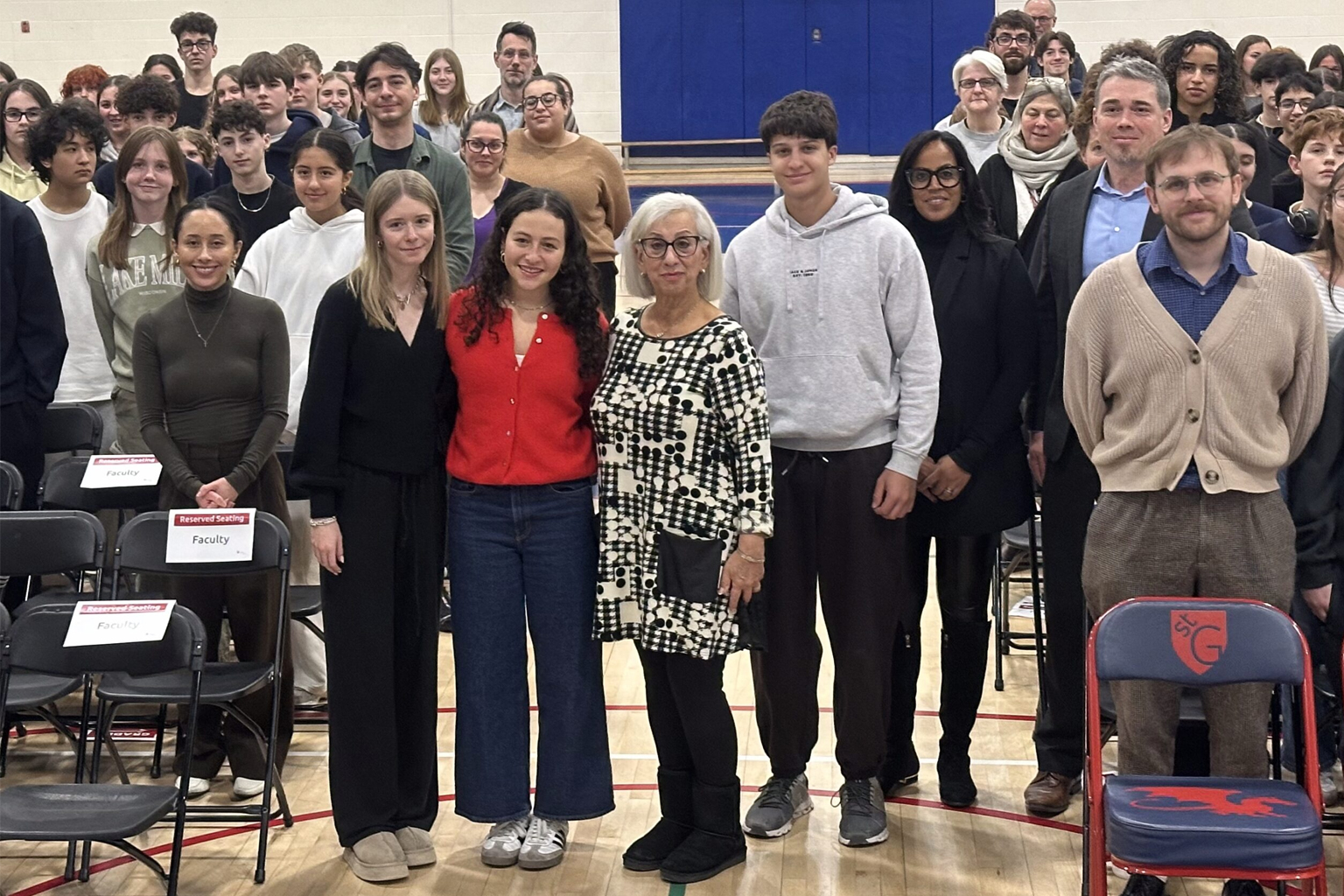
This past Tuesday, St. George’s High School students from Grades 7 through 11, along with the Grade 12 Pre-University cohort, gathered to mark International Holocaust Remembrance Day. The assembly opened with a moving candle-lighting ceremony led by three High School students alongside our guest speaker, Barbara Cieply, in honour of those lost and those who survived, setting a tone of deep respect and community reflection.
Partnering for Change: The Foundation for Genocide Education
At St. George’s, we believe that education is our most powerful tool against hatred. Continuing an ongoing relationship with The Foundation for Genocide Education, we welcomed speaker Barbara Cieply, who shared her family’s story of survival, bridging the gap between historical fact and lived experience. A member of the Foundation’s dedicated team of presenters, comprising survivors and children of survivors, Barbara’s testimony ensures that history is learned through the voices of those who lived it.
“Our mission is to ensure that the history of the Holocaust and other Canadian-recognised genocides—and the steps leading to them—are taught in all Quebec high schools, so that students understand the real consequences of antisemitism and other forms of hate.”
— Janie Halickman, Educational Outreach Coordinator, The Foundation for Genocide Education
Bearing Witness to Personal Tragedy
The daughter of Holocaust survivors, Barbara shared the extraordinary story of her mother, Regina Kleinberg-Cieply. Through family photographs and poignant video testimonials, students learned how Regina escaped the Warsaw Ghetto at just twelve years old. To stay alive, she assumed various non-Jewish identities, living among strangers and navigating a world of constant peril through sheer luck and resourcefulness. Barbara also spoke of her father’s resilience in the Auschwitz death camp and daring escape through the forest while on a death march, weaving a narrative that encouraged students to make connections between past atrocities and contemporary instances of intolerance.
“Holocaust education demands that we listen, reflect, and bear witness to the voices and testimony of survivors. While this task is difficult, it is both necessary and a privilege. Bearing witness is not solely for the listener, nor is it for the survivor; it is for everyone. Bearing witness and genocide education have to ensure that “Never Again” is not just a slogan, but a call to action, and a promise kept.”
— Bryden Streeter, Social Sciences Teacher
Navigating the Modern Funnel of Hate
A critical component of the assembly addressed the challenges we face today, particularly with the rise of hate crimes and intolerance, fueled in part by social media. Barbara discussed how algorithms can act as a “funnel,” leading users toward racist, anti-Muslim, and antisemitic content.
“It is vital for students to hear stories like Barbara Cieply’s; her family’s experiences demonstrate the reality and results of unchecked hate and teach us to stand up to injustice. Social media encourages misinformation to propagate quickly, which is why it is essential to establish historical facts and provide students with proper education about tragedies like the Holocaust.”
— Ethan Lubarsky, Grade 10 Student
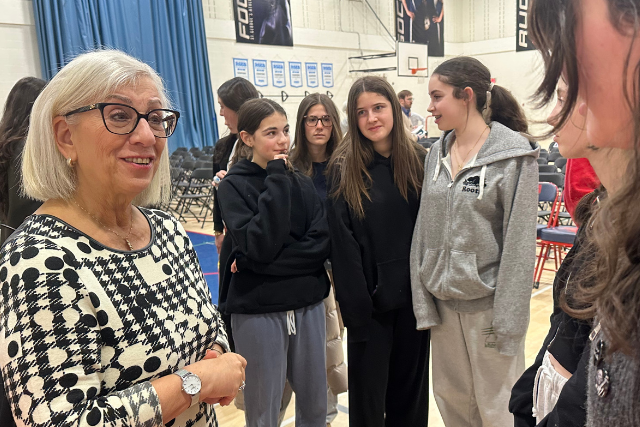
During a candid Q&A session, a student asked Barbara if she thought social media could incite hatred toward groups a person has never encountered. Barbara’s confirmation and explanation of how algorithms reinforce bias empowered students to think critically about their own digital habits and the importance of challenging propaganda in real-time.
The assembly reinforced that genocide does not begin with mass violence; it begins with words and the “roots of intolerance.” By studying these warning signs, St. George’s students learned that “Never Again” must be more than a slogan; it is a promise kept through daily acts of inclusion and courage to speak out.
Looking Ahead
Aligned with our commitment to social-emotional learning and global citizenship, we continue to refine and expand our approach to these important themes across all levels of the school. This learning experience is closely aligned with our school’s Statement of Commitments, which affirms a pedagogical approach rooted in empathy, understanding, and respect. The Holocaust is a pivotal historical example of what can happen when prejudice, dehumanisation, and intolerance are normalised. Studying it allows students the opportunity to reflect on the importance of shared humanity and the inherent value of human life, principles that are at the foundation of all meaningful dialogue and learning at St. George’s.
Interested in St. George’s?
Learn more about our school and be the first to hear about upcoming events.
[YEAR ROUND] General Optins
Elementary School Campus
3685 The Boulevard
Westmount, QC H3Y 1S9
High School Campus
3100 Le Boulevard
Montréal, QC H3Y 1R9
Admissions
514-904-0542
admissions@stgeorges.qc.ca



© 2026 | Terms of use | Privacy policy